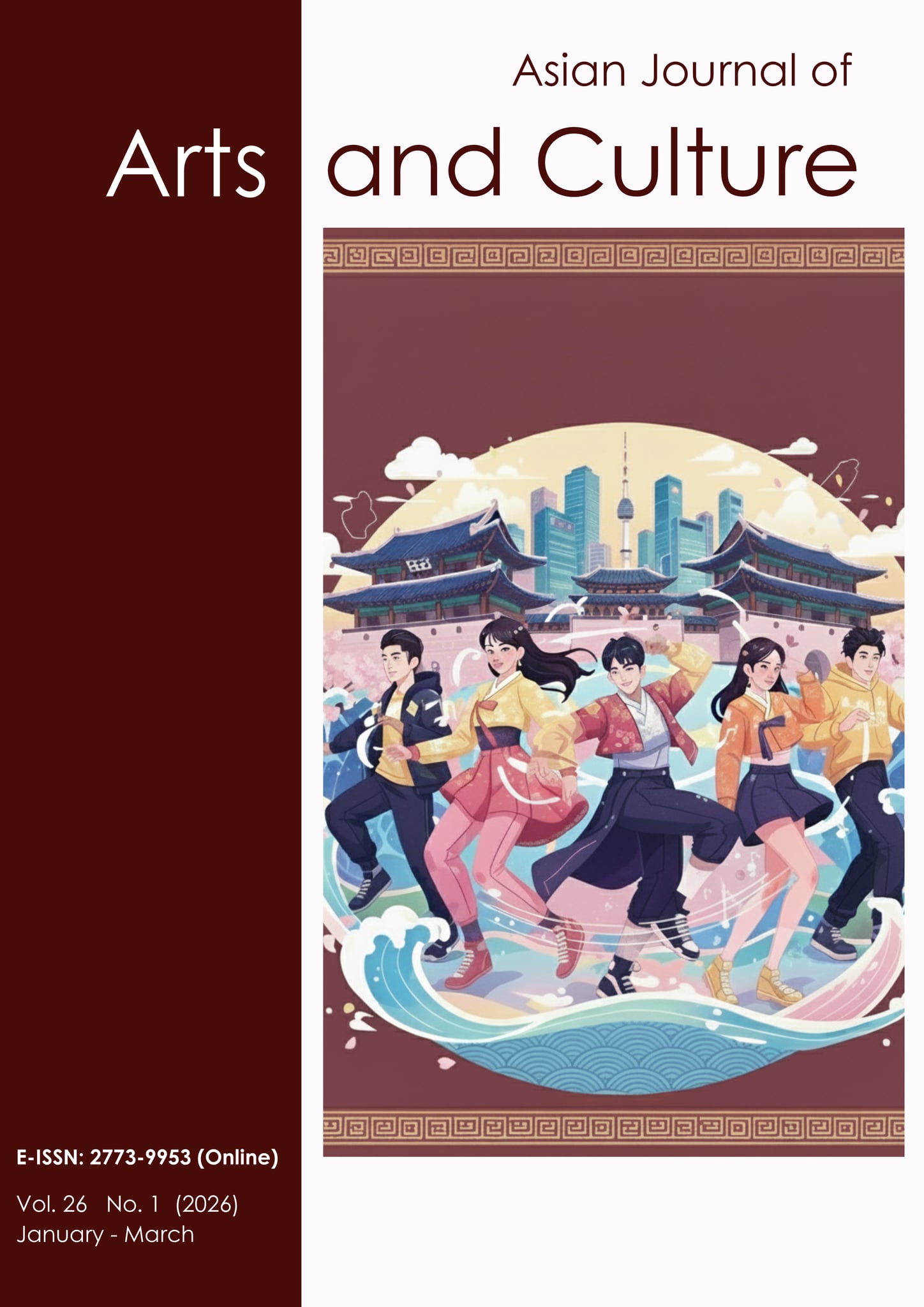
Black Women, K-pop, and Global Fandom: A Critical Intersectional Review
DOI:
https://doi.org/10.48048/ajac.2026.17Keywords:
Black women, K-pop, Fandom, Intersectionality, Cultural appropriation, Racial capitalism, Hybridity, Transnational popular cultureAbstract
This study systematically reviews and investigates the relationship between African American and K-pop fandom, examining how hybridity, cultural appropriation, racial capitalism, and identity work shape their participation in a globalised cultural form. A thematic literature review was conducted, drawing on 62 peer-reviewed literature sources published between 2000 and 2024. Databases searched included Web of Science, Scopus, ProQuest, and Google Scholar. Keywords included K-pop, Black women, fandom, intersectionality, cultural appropriation, racial capitalism, and hybridity. Inclusion criteria prioritised works addressing race, gender, and fandom politics in relation to Korean popular culture. The analysis identifies five interlinked contradictions shaping Black women’s positionality in K-pop fandom: (1) the simultaneous familiarity and distance produced by K-pop’s Black cultural foundations, (2) the celebration of Black aesthetics alongside their erasure within industry structures, (3) the provision of gendered affective alternatives tempered by persistent stereotypes, (4) the coexistence of inclusive branding and anti-Black exclusion in fandom spaces, and (5) the tension between identity re-creation, activism, and the policing of critique. This review addresses a critical gap in fandom studies by centring Black women’s perspectives, revealing how their cultural affinity for K-pop coexists with racialised marginalisation, and developing a transferable framework for analysing contradictions in other transnational popular cultures.
Highlights
- Reveals how K-pop’s African American cultural roots foster affinity while industry structures perpetuate racial exclusion
- Identifies five interlinked themes: hybridity, cultural appropriation, gendered affective connections, anti-Blackness, and identity re-creation.
- Demonstrates how Black women use fandom as a site for activism, cultural translation, and resistance.
- Offers a transferable framework for studying race, gender, and global fandom politics across transnational popular cultures.
Downloads
References
Ahmed, S., & Ahmed, S. (2020). On being included: Racism and diversity in institutional life. Duke University Press.
Anderson, S. (2021) ‘Black women’s sonic familiarity with K-pop: Musical resonance and cultural proximity’. Journal of Popular Music Studies, 33(1), 53-68.
Bhabha, H. K. (1994) The location of culture. London: Routledge.
Braun, V., & Clarke, V. (2006). Using thematic analysis in psychology. Qualitative research in psychology, 3(2), 77-101.
Collins, P. H. (2000). Black feminist thought: Knowledge, consciousness, and the politics of empowerment (2nd eds.). New York: Routledge.
Condry, I. (2006). Hip-Hop Japan: Rap and the paths of cultural globalization. Durham: Duke University Press.
Craig, M. L. (2006). Ain’t I a beauty queen? black women, beauty, and the politics of race. New York: Oxford University Press.
Crenshaw, K. (1991). ‘Mapping the margins: Intersectionality, identity politics, and violence against women of color’. Stanford Law Review, 43(6), 1241-1299.
Fairclough, N. (1995). Critical discourse analysis: The critical study of language. London: Longman.
Fraser, N. (1999). Rethinking the public sphere: A contribution to the critique of actually existing. democracy (pp. 109-142). In Calhoun, C. (Ed.). Cambridge, MA: Habermas and the Public Sphere.
George, N. (2004). Hip Hop America. New York: Penguin.
Gill, R. (2010). Life is a pitch: Managing the self in new media work. Managing media work, Vol(No), 249-262.
Gilroy, P. (1993). The black Atlantic: Modernity and double consciousness. London: Verso.
Rutherford, J. (1990). Identity: Community, culture, difference. London, UK: Lawrence & Wishart.
Hall, S. (1997). Representation: Cultural representations and signifying practices. London: SAGE.
Hooks, b. (1992). Black looks: Race and representation. Boston: South End Press.
Howard, K. (2022). ‘K-pop female idols in the West: Gender, race and global media industries’, Popular Music, 41(1), 14-30.
Jenkins, H. (1992). Textual poachers: Television fans and participatory culture. New York: Routledge.
Jenkins, H. (2006). Convergence culture: Where old and new media collide. New York: NYU Press.
Jung, S. (2011). K-pop, Indonesian fandom, and social media. Jakarta, Indonesia: Gramedia.
Jung, S. (2013). K-pop beyond Asia: Performing transnationality, transgressing the nation. London: Routledge.
Kozinets, R. V. (2010) Netnography: Doing ethnographic research online. London: SAGE.
Kvale, S. & Brinkmann, S. (2009). Inter views: Learning the craft of qualitative research interviewing (2nd eds.). Thousand Oaks, CA: SAGE.
Lee, H. K. (2018). ‘Gender, identification and desire among Korean viewers of second-wave Korean dramas’, Asian Journal of Communication, 28(2), 101-118.
Lie, J. (2014). K-pop: Popular music, cultural amnesia, and economic innovation in South Korea. Berkeley, CA: University of California Press.
Macon, A. (2019). ‘Playing with blackness: Critical race humour and the shifting dynamics of Black identity in South Korean media. Cultural Studies, 33(1), 88-102.
Olutola, F. (2024). Fangirling while Black: K-pop, affect, and the reproduction/rejection of Blackness. Popular Music and Society, 47(1), 48-64.
Pillow, W. (2003). ‘Confession, catharsis, or cure? Rethinking the uses of reflexivity as methodological power in qualitative research’. International Journal of Qualitative Studies in Education, 16(2), 175-196.
Robinson, C. J. (1983.) Black Marxism: The making of the black radical tradition. London: Zed Press.
Rogers, R. A. (2006) ‘From cultural exchange to transculturation: A review and reconceptualization of cultural appropriation’. Communication Theory, 16(4), 474-503.
Shin, H. (2021) ‘Melodramatizing racialized Korea: The impasse of Black representation in Itaewon Class’. Journal of Korean Studies, 26(2), 75-90.
Sobande, F. (2020). Sobande, F. (2020). Black women and the media in Britain (pp. 29–64). In F. Sobande (Ed.), The digital lives of Black women in Britain. Cham, Switzerland: Springer International Publishing.
Trier-Bieniek, A. (2015) Fan girls and the media: Consuming culture. Lanham: Rowman & Littlefield.
Williams, A. (2020) ‘Got S(e)oul? The cultural implications of performing blackness in K-pop on South Korean youth., Journal of Popular Music Studies, 32(3), 39-55.
Wright, K. (2022). Black girls and Korean popular culture: Embodying K-pop fandom beyond the U.S. Visual Arts Research, 49(2), 52-64.
Jin, K. Y. Y., Yoon, K., & Min, W. (2021). Transnational Hallyu: The globalization of Korean digital and popular culture. London, UK: Bloomsbury Publishing PLC.