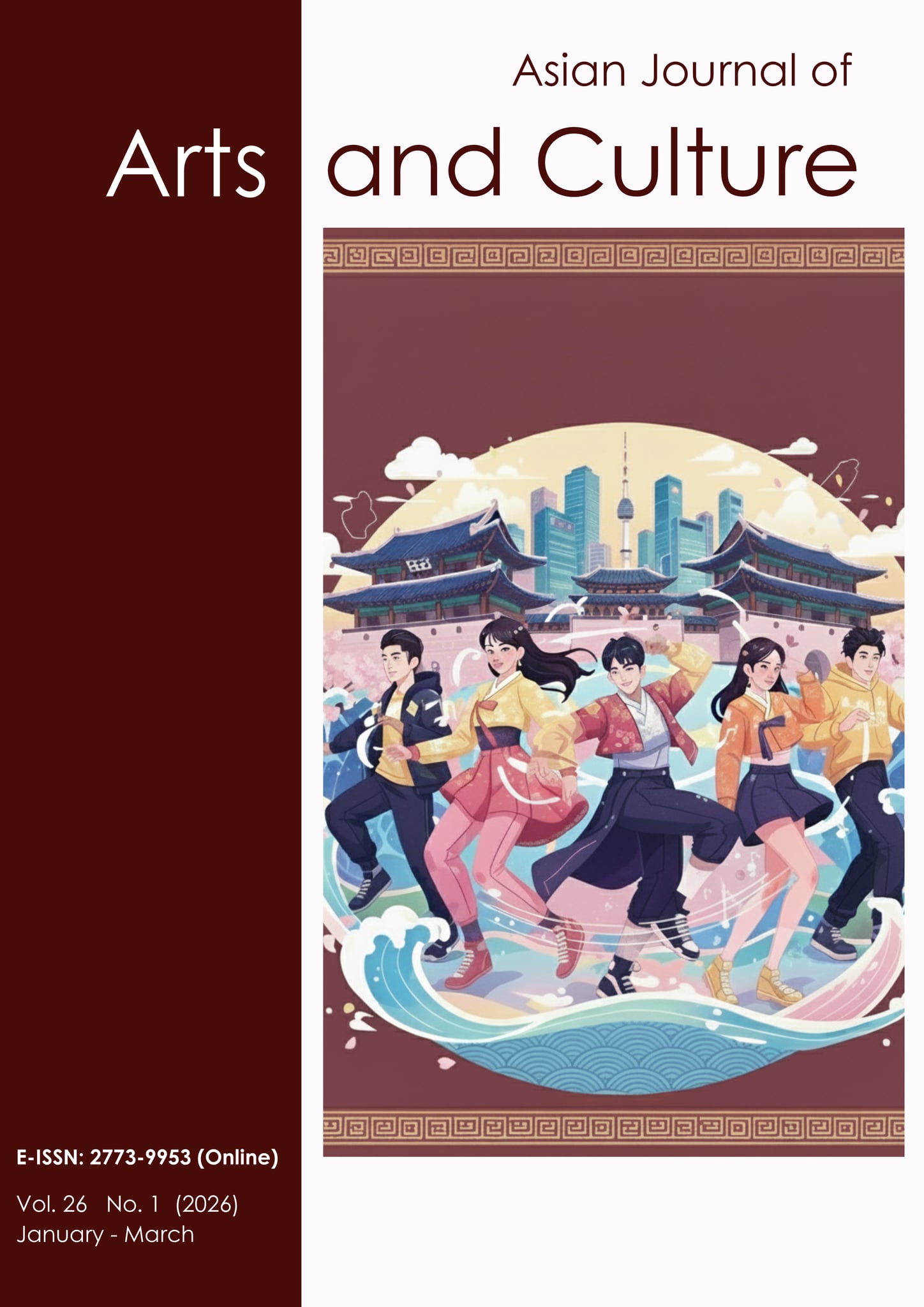
KPop Demon Hunters: Cultural Representation in Contemporary Korean Animation
DOI:
https://doi.org/10.48048/ajac.2026.16Keywords:
Hallyu, Culture representation, Animation, Korean wave culture, K-PopAbstract
The Korean Wave (Hallyu) has become a global cultural force, extending South Korea’s influence through K-pop, television dramas, films, cuisine, language, tourism, and consumer products. While these cultural forms have been widely examined in live-action media, animation remains a relatively underexplored channel for Hallyu’s cultural representation and soft power projection. Addressing this gap, this study investigates the KPop Demon Hunters, an English-language Korean animated film, to analyze how elements of Hallyu culture are embedded and communicated to international audiences. Guided by representation theory, this research employs a qualitative textual analysis, applying a multidimensional framework comprising idols, music, films/series, food, language, travel, and products. The analysis focuses on how cultural signs are encoded within the film’s narrative, visuals, and sound design, shaping both the authenticity and accessibility of Korean culture for a global audience. Findings reveal that the film interweaves contemporary K-pop performance aesthetics such as choreography, costumes, and concert cinematography with traditional Korean mythology, attire, and symbolic landscapes. Iconic landmarks such as the Namsan Tower and vibrant urban streetscapes subtly promote Korea’s image as a travel destination. Food scenes featuring gimbap (Korean rice rolls), ramyeon (instant noodles), and other street dishes highlight everyday culinary culture, while the inclusion of Korean terms such as maknae (youngest) and hoobae (junior) reinforces linguistic authenticity and cultural hierarchy. The soundtrack blends original K-pop-style tracks with well-known K-drama OSTs, fostering intertextual connections that deepen audience engagement. This study demonstrates that animation can serve as an effective medium for cultural representation, capable of merging entertainment value with strategic cultural promotion. By extending the analysis of Hallyu beyond live-action media, the research contributes to cultural and media studies scholarship while offering insights for creative industries on how animation can be leveraged to strengthen South Korea’s global cultural presence.
Downloads
References
Chan, W. & Chi, S. (2011). Popular media as a motivational factor for foreign language learning: the example of the Korean wave (pp. 151-188). In Chan, W., Chin, K., Nagami, M., & Suthiwan, T. (Ed.). Media in Foreign Language Teaching and Learning. Berlin, Boston: De Gruyter Mouton.
Bakytzhanova, A., & Tuleshova, L. (2023). K-Pop as a main tool of Korean ‘soft power’ towards Central Asia. Journal of Central Asian Studies, 92(4), 17-28.
Billboard Global 200. (2025). Billboard. Retrieved from https://www.billboard.com/charts/billboard-global-200/
Choi, B., & Yu, J. (2025, August 10). KPop Demon Hunters is a global musical sensation. The Chosun Daily. Retrieved from https://www.chosun.com/english/kpop-culture-en/2025/08/10/C67YWI7BMBAT3B7GWSUYHYI6QA/
Chuppunnarat, Y., Sangvanich, K., Laovanich, V., Achayutthakan, M., Saibunmi, S., & Suwanphithak, W. (2020). The influence of external cultures on art, music, and dance education students: A case study of Thailand and Lao PDR. Humanities, Arts and Social Sciences Studies, 20(2), 582-603.
Dainton, M., & Zelley, E. D. (2022). Applying communication theory for professional life: A practical introduction. United Kingdom: Sage Publications.
de Oliveira, C. V. A. (2025). The hallyu wave as a strategic soft power tool: South Korea’s cultural diplomacy in the 21st century. Scielo Preprints. Retrieved from https://doi.org/10.1590/SciELOPreprints.12388
Fan, X., & Komolsevin, R. (2024). Exploring cultural representation: A case study of foreign cultures in the Chinese television program “informal talks”. BU Academic Review, 23(2), 60-79.
Fu, K., & Liew, K. K. (2008). Pop culture bridges Korea and Singapore. Seoul, South Korea: The Korea Herald.
Manalo, M. (2025). Huntrix don’t miss with ‘Kpop Demon Hunters’ – Review. Geeks of Color. Retrieved from https://geeksofcolor.co/2025/08/23/kpop-demon-hunters-review/
Hall, S. (1997). Representation: Cultural representations and signifying practices. New Delhi, India: Sage.
Havens, L., Lipshutz, J., & Unterberger, A. (2025, July 13). ‘Kpop Demon Hunters’ soundtrack: All 12 tracks ranked. billboard. Retrieved from https://www.billboard.com/lists/kpop-demon-hunters-soundtrack-best-songs-ranked-review/
Hong, E. (2025, August 16). Opinion | Why ‘KPop Demon Hunters’ is a good movie. The New York Times. Retrieved from https://www.nytimes.com/2025/08/16/opinion/kpop-demon-hunters-globalism.html
Hoskins, P. (2025, July 4). Fictional K-pop bands beat BTS and Blackpink in US charts. BBC. Retrieved from https://www.bbc.com/news/articles/clyl1zyv1y2o
Jin, D. (2016). New Korean wave: Transnational cultural power in the age of social media. Chicago, United States: University of Illinois press. https://muse.jhu.edu/book/45293
Kang, M., & Appelhans, C. (2025). Kpop Demen Hunters [Film]. Netflix; Sony Pictures Animation Inc. Retrieved from https://www.netflix.com/title/81498621
Kim, M. (2022). The growth of South Korean soft power and its geopolitical implications. Journal of Indo-Pacific Affairs, 5(6), 123-138.
Kim, N. Y. (2025). “KPop Demon Hunters” director: “lion boyz’s Jinwoo and cha eunwoo inspired” [Star Issue]. Retrieved from https://m.entertain.naver.com/home/article/108/0003340549 [In Korean].
KOCIS. (2023). The world of K-story meets your eyes. KOCIS. Retrieved from https://www.kocis.go.kr/eng/webzine/202302/sub06.html
Korea Creative Content Agency. (2024). 2023 white paper on the animation industry. Korea Creative Content Agency (KOCCA). Retrieved from https://welcon.kocca.kr/mobile/en/support/resources/120
Lee, J. Y. (2025). Kpop Demon Hunters: How the Netflix film became a global sensation. BBC. Retrieved from https://www.bbc.com/culture/article/20250715-the-animated-k-pop-film-that-swept-the-world
Lee, S., & Nornes, A. M. (2015). Hallyu 2.0. Ann Arbor, United States: University of Michigan Press.
Lie, J. (2014). K-pop: Popular music, cultural amnesia, and economic innovation in South Korea. Berkeley, United States: University of California Press.
Lin, Y., Nettayakul, D., & Kingminghae, W. (2022). Chineseness, situatedness, and what the Thai-Chinese see in Chinese dramas. Media Asia, 50(1), 82-96.
Manalo, M. (2025). Huntrix don’t miss with ‘Kpop Demon Hunters’. Geeks of Color. Retrieved from https://geeksofcolor.co/2025/08/23/kpop-demon-hunters-review/
Maneechaeye, P. (2021). The commodification of idol culture with a loot-boxes-style marketing strategy practice in Thai idol culture and aspects of consumer psychology toward uncertainties. Humanities, Arts and Social Sciences Studies, 21(2), 179-187.
Morrison, J. (2025). How Kpop Demon Hunters reached 236M views in 2025 and why a sequel looms. Red94. Retrieved from https://www.red94.net/news/58956-how-kpop-demon-hunters-reached-236m-views-in-2025-and-why-a-sequel-looms/
Nye, J. S. (2004). Soft power: The means to success in world politics. New York: Public Affairs.
Oh, I., & Lee, H. (2014). K-pop in Korea: How the pop music industry is changing a post-developmental society. Cross-Currents: East Asian History and Culture Review, 3(1), 72-93.
Oh, I., & Park, G. S. (2013). The globalization of K-pop: Korea’s place in the global music industry. Korea Observer, 44(3), 389-409.
Onnom, K. (2018). Influence of South Korea’s soft power on the extention of Korean language in Thailand (Master’s thesis). Thailand: Chulalongkorn University.
Park, J. H. (2025). Why are K-pop stars obsessed with ‘KPop Demon Hunters’? The Korea Times. Retrieved from https://www.koreatimes.co.kr/entertainment/k-pop/20250720/why-are-k-pop-stars-obsessed-with-netflix-animation-kpop-demon-hunters
Punnahitanond, R. (2018). Portrayal of Thailand by international news media and its impact on international audiences’ travel intention through perceived country image: A case study of the Thai cave rescue. BU Academic Review, 17(2), 89-103.
Punnahitanond, R., Supalakwatchana, S., & Fan, X. (2025). The impact of Korean and Chinese cultural presentations on cultural preferences of Thai audiences in generational differences. Journal of Business Administration the Association of Private Higher Education Institutions of Thailand, 14(1), 115-133.
Rika-Go. (2025). Idol covers of “golden” are everywhere, but these are the Standouts. Allkpop. Retrieved from https://www.allkpop.com/article/2025/08/idol-covers-of-golden-are-everywhere-but-these-are-the-standouts
Samovar, L. A., Porter, R. E., McDaniel, E. R., & Roy, C. S. (2012). Communication between cultures. Boston, United States: Cengage Learning.
Shim, D. (2006). Hybridity and the rise of Korean popular culture in Asia. Media, Culture & Society, 28(1), 25-44.
Stephan, K. (2025). Inside the viral success of ‘KPop Demon Hunters’: ‘fashion, weird girls and great pop music.’ Variety. Retrieved from https://variety.com/2025/film/news/kpop-demon-hunters-soundtrack-success-1236444840/
Suebsaeng, K. (2020). The impact of media exposure on the admiration of K-pop artists among Thai teenagers in Bangkok. Webology, 17(4), 261-269.
Zhang, L. (2024). South Korea’s soft power to China: Taking K-pop as an example. Transactions on Social Science, Education and Humanities Research, 5, 99-103.