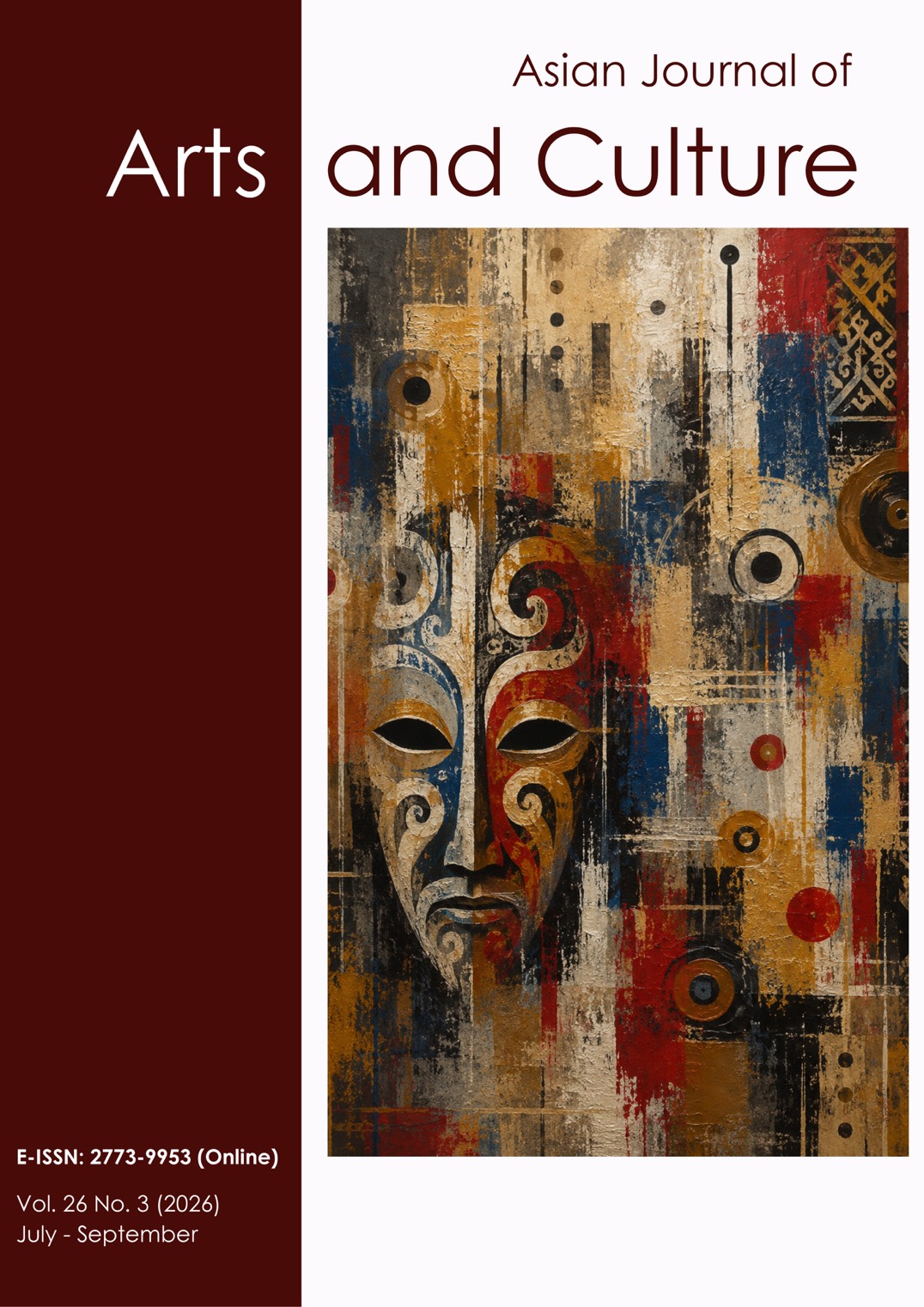
A Cross-Cultural Comparative Study of the Dai Peacock Dance in China and the Kinnara/Kinnari Image in South and Southeast Asia
DOI:
https://doi.org/10.48048/ajac.2026.101Keywords:
Kinnara/Kinnari, Chinese Dai Peacock Dance, Theravada Buddhism, Cross-cultural comparison, South East AsiaAbstract
Based on the anthropological cultural circle theory, this study systematically sorts out the core characteristics of Kinnara/Kinnari in the Theravada Buddhism cultural circle of South and Southeast Asia, as well as their localized evolution path after being introduced to the Dai-inhabited areas of Yunnan, China. Adopting the literature research method, field investigation method, and comparative research method, this study first verifies the cross-regional unity of the Kinnara/Kinnari cultural circle, then analyzes the dual-track localization logic of the “Kinnara Dance” and “Peacock Dance” in the Dai-inhabited areas of China, and finally distinguishes the similarities and differences between the two and the core elements of the Kinnara/Kinnari cultural circle from the dimensions of mythological connotations, artistic forms, and cultural functions. The research results indicate that cultural identity is not a static and fixed entity but a dynamically constructed product in the process of cross-cultural interaction. By transforming and adapting elements of the cultural circle, the Dai people have shaped a unique artistic identity in the dialogue between South and Southeast Asian cultures and local characteristics. This study provides a theoretical basis and practical reference for the protection of cross-border cultural heritage and artistic mutual learning in the context of globalization.
Highlights
Addresses critical gaps in existing scholarship: Fills the research void regarding potential linkages between Kinnara/Kinnari culture—previously examined primarily within core regions of the Theravada Buddhist cultural sphere in South and Southeast Asia—and Chinese Dai culture. It also addresses the insufficient discussion of cross-cultural origins in prior studies on the Chinese Dai Peacock Dance, which have notably focused on single-region case descriptions.
Establishes a systematic cross-cultural analytical framework: For the first time, explicitly connects South and Southeast Asian Kinnara/Kinnari culture with the Chinese Dai Peacock Dance, while delineating the complete cultural trajectory of “Indian origin → Southeast Asian dissemination → localization among the Chinese Dai people.”
Derives generalizable academic conclusions: Summarizes universal laws governing the localization of South and Southeast Asian cultures through in-depth analysis of specific cultural cases, thereby providing valuable insights for analogous cross-border and cross-ethnic cultural research.
Downloads
References
Akhil, K. N., & Nayar, P. (2022). Kinnaras and kinnaris in South and Southeast Asian art. In Syncretism in sculptural art of South and Southeast Asia, 37(3) ,172-182.
Chen, S. S. (2017). A study on the historical forms of the Dai peacock dance in Ruili (Master’ s thesis). China: Yunnan Arts University.
Moore, E., & Maw, S. S. (1995). Flights of fancy: Hintha and kinnaya, the avian inspiration in Myanmar art. Oriental Art, 41(2), 25-31.
Peng, Li. (2024). The cultural interpretation of the Kinnara Divine Bird Dance of the Dai Le people in northern Thailand. Journal of Beijing Dance Academy, 33(02), 118-124.
Sharma, M. (2015). Between men and gods: Kinnaras in texts and in the Ajanta murals (pp. 149-162). In Proceedings of the South Asian Archaeology: Fifteenth International Conference of the European Association of South Asian Archaeologists. Leiden, Netherlands: Universiteit Leiden.
Shen, B. (2022). The transition from the manifestation of holiness to aesthetics: The trajectory of the evolution and dissemination of the peacock dance from the perspective of images and oral accounts. Journal of Beijing Dance Academy, 25(01), 52-63.
Tang, G. (2003). Cultural Circle theory and Shamanism cultural circle. Manchu Studies, 37(2), 132-136.
Yang, M. K. (2014). The performance of the peacock dance in the context of Theravada Buddhism and its ethnic cultural identity. Ethnic Arts, 41(05), 55-63.
Yang, Z. S. (2012). The secular charm of the Buddhist kingdom in the west: The three stupas of Sanchi. Beijing, China: SDX Joint Publishing Company.
Zhu, H. Y. (2018). The “past and present” of the Dai peacock dance music. Chinese Music, 35(01), 62-68.